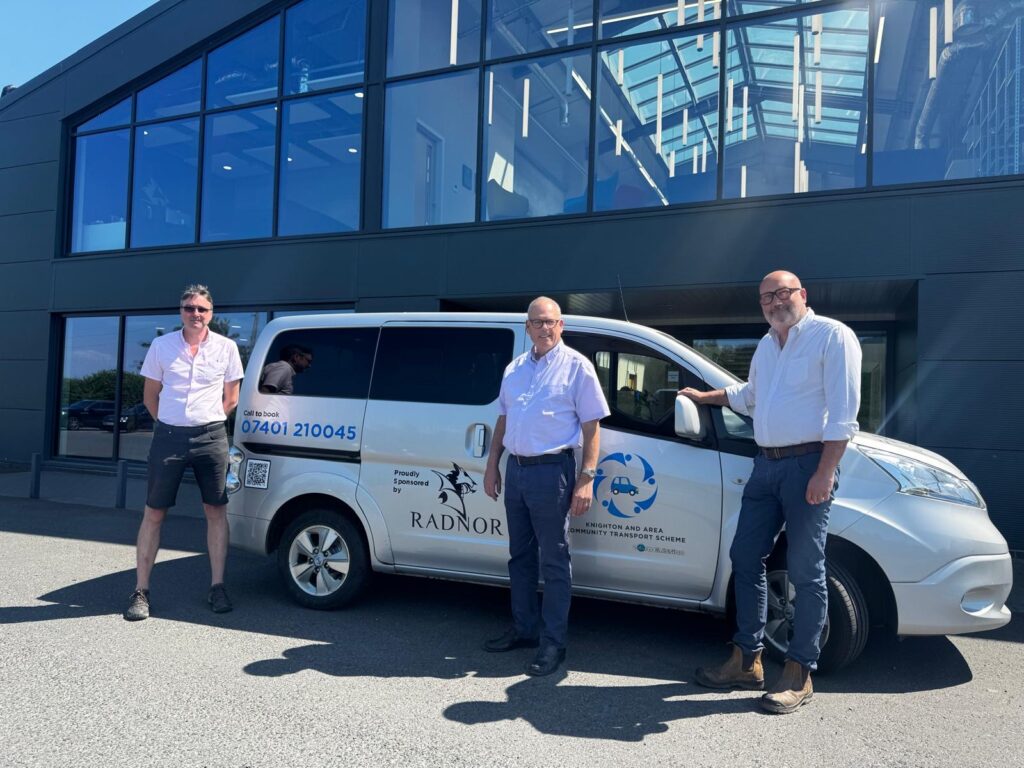
Proud to sponsor Knighton & Area Community Transport Scheme
We’re proud to be sponsoring the electric car which powers Knighton & Area Community Transport Scheme.
The scheme was formed in August last year to help people without access to transport to attend essential medical appointments.
It is run by a team of volunteers who are urgently looking for more drivers and coordinators who can give their time and get involved as well as people to help with social media.
Andrew Craggs, Chair of Trustees for Knighton & Area Community Transport Scheme, which is 100% volunteer funded, said: “It means so much to have the support of Radnor Hills and for them to sponsor our community car.
“Since we launched we have helped hundreds of people to get to appointments as far away as Gobowen, Clun and Hereford but there are too many rides we haven’t been able to do.
“We have an amazing team of volunteers, but we desperately need more. Our drivers, who can claim 45p for each mile they drive, are the backbone of the scheme, giving their time to help people get to their much-needed appointments.
“One of our drivers has recently retired and moved to Knighton with his wife. He volunteered for driving soon afterwards and says it’s been ‘a life saver for him’ because he has met so many people and has made some special friends.
“But if driving isn’t your thing, we’re also looking for people who can spare a couple of hours to be a co-ordinator. This role is essential as it connects the client with the driver and ensures everything runs smoothly. We’re looking for people with just the most basic of computer skills, as they will work alongside our other lovely co-ordinators and be given lots of training.
“We’re also local for people with social media skills and organisational skills to join our team.
“Our hope is for the scheme to grow, and to offer much more to the community, but it cannot do that without the people to help. We are very lucky with the volunteers we have, but we could help so much more.”
Chris Butler, Marketing Manager of Radnor Hills, said: “Each year we strive to give back and raise awareness of important causes.
“We’re based in a very rural area, just down the road from the Knighton & Area Community Transport Scheme, so it’s an amazing partnership for us which we’re proud to support.”
If you would like to find out more about Knighton & Area Community Transport Scheme or to become a volunteer please call 07410 438688 or visit their Facebook page.
-
Back to school with Radnor Hills
Over the past 12 months we have identified a clear
-
Radnor Splash outperforming flavoured water category with help of Price Marked Packs
At Radnor Hills we’re seeing record growth f
-
Radnor Fruits gets Disney and Pixar Toy Story 5 makeover ahead of blockbuster release
We’re delighted to be continuing our collabo
Join the Community